
Energy & Recovery
Sleep and Men's Daily Energy: A Week of Rest Observations
Adam Rahman · 12 February 2026
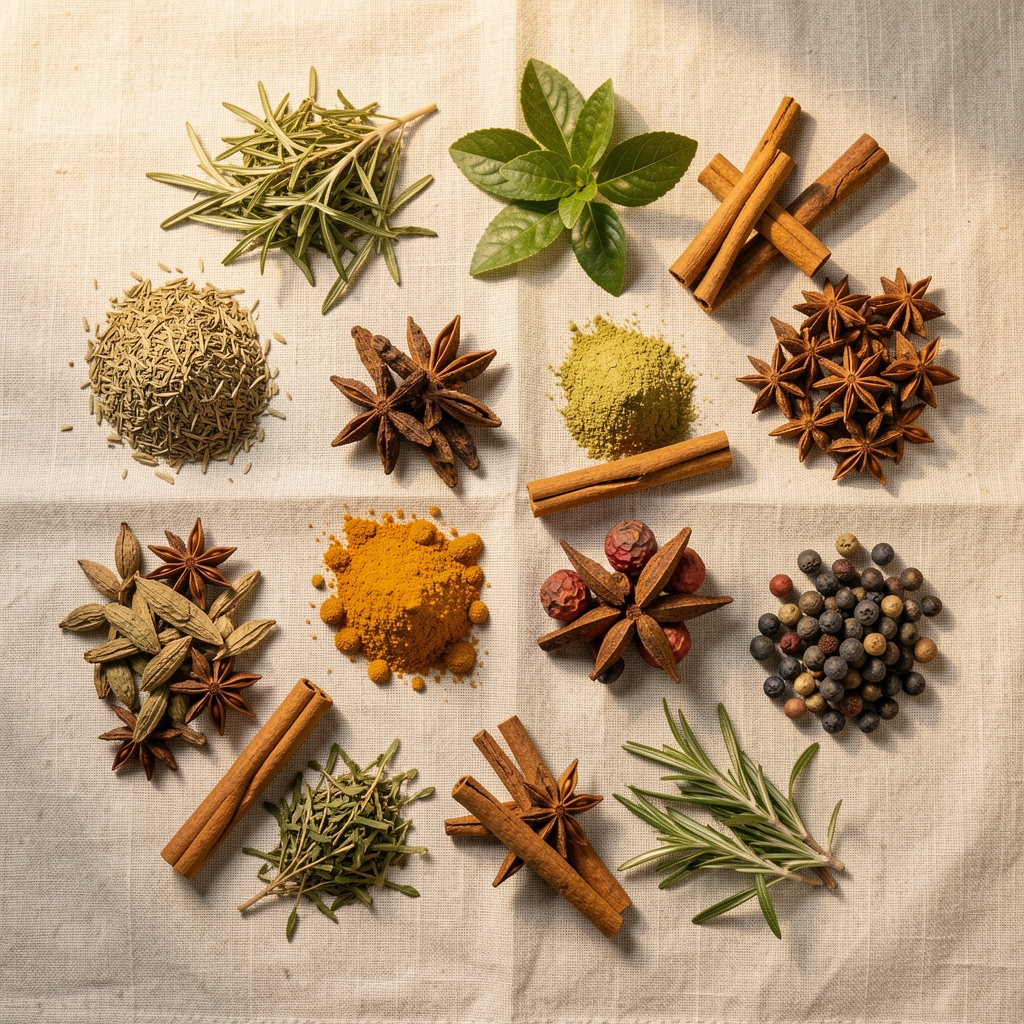
The Malaysian kitchen has always been, in part, a wellness pantry. Long before the language of nutritional awareness entered public discourse, the botanical ingredients of Malay, Chinese, and Indian cooking traditions in this country carried a parallel purpose: nourishment not just of appetite but of daily physical resilience. This is an editorial review of some of those ingredients — what the tradition holds, what the published wellness literature observes, and what the everyday pantry of an active Malaysian man might reasonably contain.
Halia — ginger, in its Malay designation — occupies a foundational position in Malaysian cooking that extends well beyond flavour. Published nutritional research identifies ginger as a source of gingerols and shogaols, compounds associated with antioxidant activity and digestive comfort in the wellness literature. Its role in traditional Malay wellness practice, documented across generations of home knowledge, emphasises its place in morning preparations: the ginger tea taken before physical activity, the ginger-infused broth consumed during periods of fatigue.
For active men in Malaysia, the association between halia and morning energy rhythm is less nutritional than habitual. The root appears in teh halia, in nasi lemak sambal, in the herbal soups of the Malay wellness tradition. It is, in this sense, a pantry constant rather than a supplement — present not because it was placed there intentionally as a wellness ingredient but because it belongs to the cooking culture that shapes daily eating.
The published wellness literature's interest in ginger is substantial. Its association with muscle recovery awareness — documented in published studies involving physical activity and post-exercise comfort — makes it a relevant ingredient to note for active men, though the editorial position here is observational: halia is what the tradition has always used, and the research corroborates what the tradition already knew.
Turmeric — kunyit in Malay — is perhaps the single botanical most thoroughly examined by contemporary nutritional research among all Malaysian pantry ingredients. Its active compound, curcumin, has been the subject of a substantial body of published wellness literature examining its antioxidant and anti-inflammatory properties. The research is nuanced and ongoing; editorial observation here will not overstate what the literature supports.
What is unambiguous is kunyit's centrality to Malaysian daily eating. It colours the nasi kunyit of celebratory meals, the rendang of festive tables, the simple rice porridge of recovery mornings. For active men in Malaysia, the presence of kunyit in the regular diet is less a wellness intervention than a cultural given — and one that the published literature consistently notes as nutritionally meaningful when consumed as part of a varied whole-food diet rather than in isolated extract form.
The bioavailability of curcumin is notably enhanced in the presence of black pepper — a combination that traditional Malaysian cooking has employed intuitively across centuries, long before the mechanism was identified in nutritional research. The editorial observation here is simply this: the traditional Malaysian pantry already contained the combination. The research arrived later.
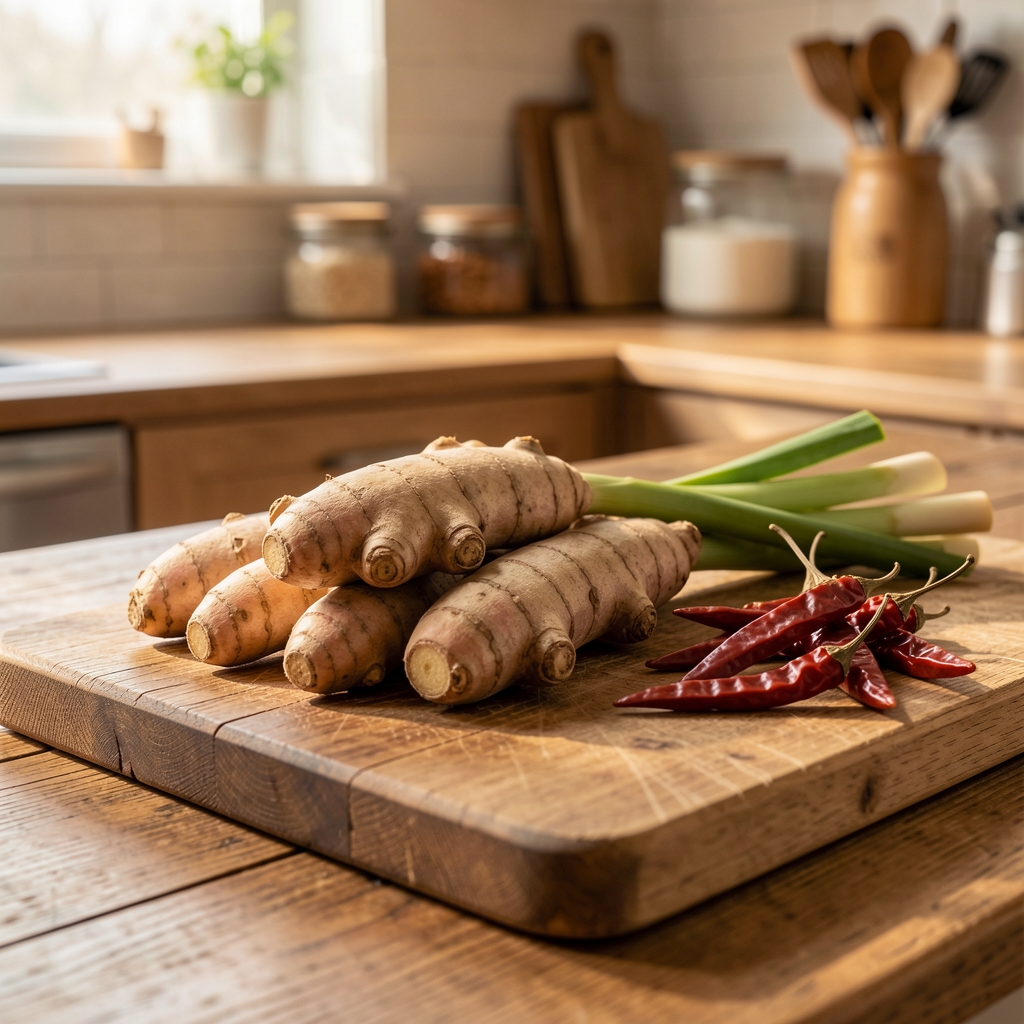
Traditional Malaysian pantry botanicals — editorial composition, Kuala Lumpur 2026
Lemongrass (serai) and pandan are less prominent in the international wellness literature than ginger and turmeric but are no less significant in the Malaysian daily eating context. Serai contributes citral and other aromatic compounds to the diet; pandan is a source of 2-acetyl-1-pyrroline, the compound responsible for its distinctive fragrance, as well as flavonoids documented in nutritional research for their antioxidant contributions.
Both ingredients appear across Malaysian daily cooking in ways that make their regular consumption almost unavoidable for those eating within the traditional food culture. Serai in the soup base, pandan in the rice pot, both as flavouring agents that carry nutritional contributions alongside their culinary function. For active men in Malaysia, this represents what might be described as a background nutritional presence — not something consumed as a wellness strategy but embedded in the everyday plate.
The editorial value of drawing attention to these ingredients is not to encourage supplementation or strategic consumption but to observe what is already present in the Malaysian food environment and note its correspondence with what the wellness literature identifies as nutritionally relevant. The pantry, in this reading, is already doing considerable work.
Ulam — the Malay tradition of consuming raw or lightly blanched leafy herbs and vegetables alongside cooked food — represents perhaps the most underappreciated dimension of traditional Malaysian nutritional practice. The ulam spread of a traditional Malay meal might include pegaga (Centella asiatica), daun kesum (Vietnamese mint), daun selom, and various other leafy greens consumed with sambal belacan or eaten plain alongside rice.
Pegaga in particular has accumulated a notable presence in the published wellness literature. Documented in research examining cognitive function awareness, stress adaptation, and circulation in traditional Southeast Asian wellness contexts, it is one of the few Malaysian botanical food items with a sustained published research profile. The traditional Malay dietary context has consumed it for generations as an everyday food rather than a wellness supplement.
For active men in Malaysia, the ulam tradition offers a readily accessible route to botanical nutritional variety that requires no supplementation, no specialist sourcing, and no departure from ordinary daily eating. It is, simply, the green edge of the Malaysian plate — and one worth preserving in an era when convenience foods increasingly displace it.
"The Malaysian pantry was always a wellness pantry. The research simply documents what the tradition already practised."
Faiz Yusof, Brantal Notebook, March 2026
The editorial position of this article is consistent with the broader stance of Brantal Notebook: observation rather than instruction. The traditional Malaysian botanical pantry — halia, kunyit, serai, pandan, ulam greens, and the broader spectrum of herbs and spices embedded in daily cooking — represents a nutritional environment that published wellness research regards as meaningfully positive in the context of whole-food dietary variety.
For active men in Malaysia, the practical implication is not a supplement protocol or a dietary overhaul. It is, rather, a closer relationship with what is already present in the food culture — an attention to the botanical dimension of daily eating that the modern convenience-food environment tends to erode. The traditional Malaysian kitchen knew this. The challenge for the active Malaysian man in 2026 is simply to keep it in the pantry.
This is an editorial observation, not an instruction. It reflects what the published wellness literature and the traditional food culture, taken together, suggest about the botanical richness of the Malaysian everyday plate. How that observation is received and whether it informs any change in daily eating is, as always at Brantal Notebook, entirely the reader's domain.
Pantry Botanicals — A Brief Reference
Written by
Faiz Yusof writes about traditional Malaysian wellness practices and botanical food culture for Brantal Notebook. His work draws on deep familiarity with Malaysia's multi-ethnic wellness traditions and published nutritional research on Southeast Asian botanical ingredients.
More from Brantal Notebook →